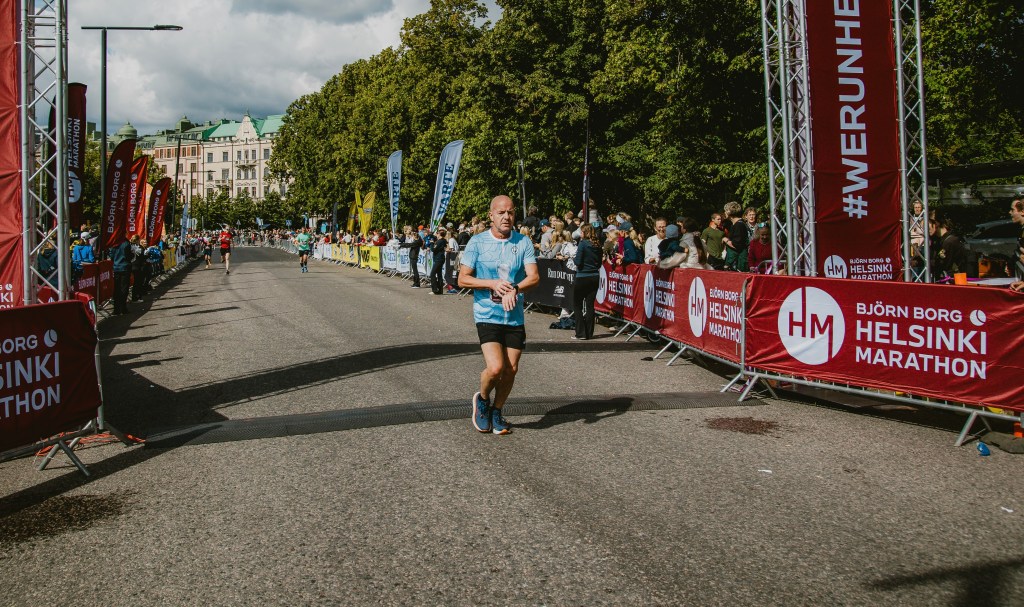
Photo: Aarni Holappa
Some context
I was keen to get another marathon in my legs, having ran my last marathon in Tokyo in 2017, where I ran out out of steam finishing in 3hrs:43mins.
I had been training for the last year, mostly shorter distances up to 20km, but since May I had increasing the length of the longer runs, including distances of 23km, 24km, 27km and a final long run of 30km 2 weeks before the Helsinki Marathon (Saturday 23rd August, 2025).
In the run up to the marathon, my weekly volume had been around 50km, well short of my pre-hiatus weekly 80km, but I’m 8 years older and having to take more recovery days hasn’t been easy. After a weird post-Covid immune response where I experienced an increase from my normal 46-48bpm to 75-80bpm resting heart rate, and excessive fatigue in my daily life lasting 2 years, I feared my running days were over. This triggered a running mid-life crisis when I realised that fast times were becoming a distant memory. This, on top of me becoming increasingly injury-prone, meant I had no other choice than to accept the new reality.
In the run-up to Helsinki, I had managed to stay injury-free, largely as a consequence of not doing excessive speed work, and the race plan was simple, just get another 42.2km in my legs and try to enjoy the experience.
I flew with Finnair from Manchester to Helsinki (3 hours) and arrived in Helsinki mid-afternoon the day before the race. I took a train into the city (30 mins) and checked into my Airbnb in the city centre. Having unpacked, I headed to the race HQ and collected my bib.
The marathon
With an 08:45 start, I walked the 2km to the start area leaving my apartment at 07:00, arriving at 07:30. There were plenty of toilets in the start area so no issues there. About 10 minutes before the start, I made my way to the start area and inserted myself in the middle of the pack which was fine with a field of just over 2,300 runners. There was a half marathon with several thousand entrants that set-off at 08:10 and a 10km run after the marathon.
My race plan was to run at a comfortable 6:05-6:10km pace. We set-off on time and after the normal first km slowness, the field evened out as we made our way around the harbour and dock area. During the first few km, my legs felt quite heavy and I feared a difficult second half. It was then that I remembered my Berlin marathon experience in 2012 where I had felt awful during the first half of the race but went on to run a then PB after rediscovering my form in the second half of the race.
I got into a groove of sorts and reached 5km in 30:19 (6:05 pace). From here we were heading out the city centre on pavements and cycle paths. The course was bumpier than I expected but this wasn’t an issue for me as I enjoy hill running and had incorporated hills into my training. After 5km, very few people were out cheering runners but there were plenty of marshals out on the course.
Even after running 25 previous marathons, I have never learned to enjoy the first half of a marathon. For me it’s always been a mental battle getting through the first half because as we all know, the race only really starts after 30km.
I don’t really remember much about 5-15km, except that I was maintaining an even pace. I was wishing I had worn my Camelbak as I was wasting quite a lot of time slowing down to drink water from paper cups at aid stations. I took my first gel (40g carbs) at 16km and subsequently every 30 mins.
By the time I reached half way (2:10:24), it was starting to become quite warm and sunny. I remember there were some quit long gradual inclines in the middle of the course although these weren’t really causing me any issues. Suddenly at 23km I noticed I was starting to enjoy myself and my earlier heavy legs were now feeling fine.
The 30km point is always a good indicator of how my race is going to end: will it be a hard but enjoyable experience; or will it be a near death experience? One never really knows, but on reaching 30km I was still feeling pretty good and maintaining an even pace. and I knew at this point things were looking quite good.
Again I wasted quite a bit of time taking-on fluids but I noticed I was making my way past quite a lot of other runners, and once we hit 35km I knew I would be ok so I pressed on.
During 35-40km I was working hard but not losing pace, and still making my way through the field. During the final 2.2km I was able to increase my pace as we rejoined the harbour area and the road and all benefitted from some crowd support. I crossed to finish line in 4:19:41, recording a negative split of 1:08.
All things considered, this wasn’t a fast race for me by any stretch of the imagination, but I achieved my target of finishing and enjoying a relatively comfortable race.
It never ceases to amaze me that I learn something from every marathon. My big realisation during this race was that I hadn’t been fuelling enough during previous races, where I would only use a maximum of 3-4 gels. I used 8 during this race and felt quite strong, albeit running much slower than in any of my previous races. I will continue with this revised fuelling strategy in future races.
The plan going forward is to push a little harder. I’m running in the Warsaw Marathon on 28th September followed by Cologne the week after. I won’t achieve my previous 3:16-3:25 times, but I will try to nudge back towards 4 hours. It’s early days in my running return so I am happy making incremental improvements for now, but the most important thing is, I am back!
Official time: 4:19:41 (6:09km pace) | out: 2:10:24 back: 2:09:17 | elevation 220m | temp: start 13c end 19c | Fuel: SiS beta endurance gels
Post-race thoughts
Course: 6/10 – Start and finish by the harbour, but not much of the course was ran on the road, rather on a system of pavements and cycle paths as the course makes its way out of the city. Quite a few points where people or cars crossed the course (though they were held back by marshals).
Organisation: 9/10 – very well organised and seamless from bib collection, start area toilets, start and finish management, and a nice Bjorn Borg marathon top available for purchase (€19).
Crowds: 5/10 – family and friends of runners were plentiful at the start and finish area, other than that quite sparse crowds (it matters to some).
Drinks stations: 7/10 – every 3-4km (great) with water and isotonic drinks available, but cups slow everyone down. I understand why they do this (sustainability) but next time I’ll bring the Camelbak. Energy blocks were available at a couple of stations later in the race.
Volunteers: 9/10 – plenty of volunteers (thank you) around the course.
Should you run the Helsinki Marathon? In a word, yes. Great organisation and a circular course has replaced the previous double loop. I also liked that this is a marathon run on a Saturday. For anyone travelling this is great as it allows some post-race rest, a beer in the evening and a day of sightseeing on Sunday. Helsinki is a nice city, walkable, good restaurants and friendly locals.
 Neutral Footprints
Leave a comment